
What Did Decluttering Get Me?
Besides angry

Hi friends,
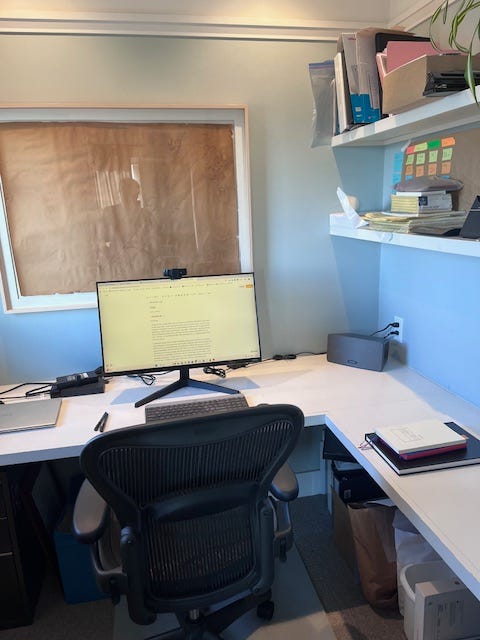
As part of my “writing detox” that was a new year’s resolution, I decided to de-clutter my desk yesterday. I wish I had taken a before picture because it was a total shit show. I found 31 notebooks (9 new, the rest had something already written in them) and 23 flash drives, which I had to methodically erase when I realized they still had evidence from old hearings on them. How old? One from 2016, another from 2019. The rest were “recent,” i.e. from 2022 and 2023. They are blank now so if anyone needs a flash drive, hit me up.
Supposedly, clutter fosters anxiety and inhibits productivity. I believe it to a certain degree because I was feeling pretty anxious that I would be crushed by notebooks and flash drives, but I’m doubtful about the productivity. With all my work put away in appropriate folders, my brain believes that there is no work to do. The five decisions that need to be written no longer exist because the files are not on my desk. Part of the clutter was a permanent To Do list. I am very “out of sight, out of mind,” as my husband will tell you. I simply do not care what’s going on in another room if I can’t see it or hear it. Unless it’s an empty room with a light on – that annoys me.
My office was so messy that I couldn’t figure out where to start on my de-cluttering project. Naturally, I googled ‘how to declutter desk’ to get started. (Please note that I have the AI Mode turned off and if I ever get AI search results, I literally close my eyes and scroll past it, I hate it that much). There are lots of videos and blogs about de-cluttering your office. I watched a couple videos and read a few pages, and what struck me was how every one of them was selling stuff. Mostly “organizational systems” that you can buy from Amazon or The Container Store. The only one that wasn’t selling tiny bins for paper clips was the Calm app, which helpfully notes the de-stressing aspects of de-cluttering, but that one ended with an ad for the Calm app.
A friend from my writing group (bear with me on this) is writing about her life in Lithuania before (and after) they gained independence. She shares small details about how they got “stuff” by bartering or showing up hours before a store opened or hording vodka (one of the few things that was easy to buy) to use as currency for labor. Need that Soviet book shelf assembled? The handyman takes vodka as payment! Essentially, there was a whole secondary economy that people actually relied on to get what they needed or what would bring them comfort. Maybe it was actually the primary economy. I don’t know.
Watching all these videos and reading this affiliate-linked-up-wazoo blogs made my think about our own secondary economy. The hustle economy. Almost 10 million people in America are reported to work two jobs but I bet the number is way higher. So many people are monetizing their “free” time by doing other work that goes unreported. Did you know that 70 million Americans are freelance? Wanna know the benefits of being freelance? Free time. That’s it. And I bet most of those workers use that free time to hustle. The US has 162 million “content creators), with 45 million people claiming it as their profession. How do they make money? With affiliate links and referral codes and probably other part-time or freelance gigs, like delivery services. [Note: Affiliate links are links to a retailer who pays the writer if their readers click through to shop on their website.]
I think about this when I am daily inundated with emails inviting me to take writing classes. Many writers are told that one of the few ways to make money writing is to teach writing to work as an editor for other writers. It’s a circular economy; very few people are paid for their writing (unless they are getting money from affiliate links, I guess). If you want to get paid for your writing, you have to write a lot and pitch a lot and submit a lot and maybe also get one of the very few writing jobs left in journalism. We’ve all been reassured that AI will replace this soon anyway. Maybe AI will also teach writing for free, too. Who knows.
Why is this happening? I imagine many people would claim that they like the free time that freelancing provides, or get an ego boost from the likes and comments on their “content.” But if all you are free to do is get another side gig or maybe get a midday doctor’s appointment, are you really free? Our economy is set up so that people do not feel like they can create for their own sake. Without the hustle, there’s not a lot of extra spending money. There certainly are no other benefits: no health insurance, no paid sick leave, no pension. Probably not much social security. Our nightmarish economy, without a social safety net, demands that millions of people “enjoy” the freedom of working several jobs while monetizing their creativity.
I wonder if any of them would like a (used) notebook and a flash drive?
On a more helpful note: one of the declutterers suggested turning all your clothes on hangers around at the beginning of the year, so the opening part of the hanger head (?) is facing you. As you wear each piece, return it to the closet with the opening facing the back, the way you usually would. At the end of the year, donate anything you didn’t wear for the whole year and start over. I thought that was a good tip. And it’s free (unless you’d like to buy these special hangers on sale now…..).
Working on it!